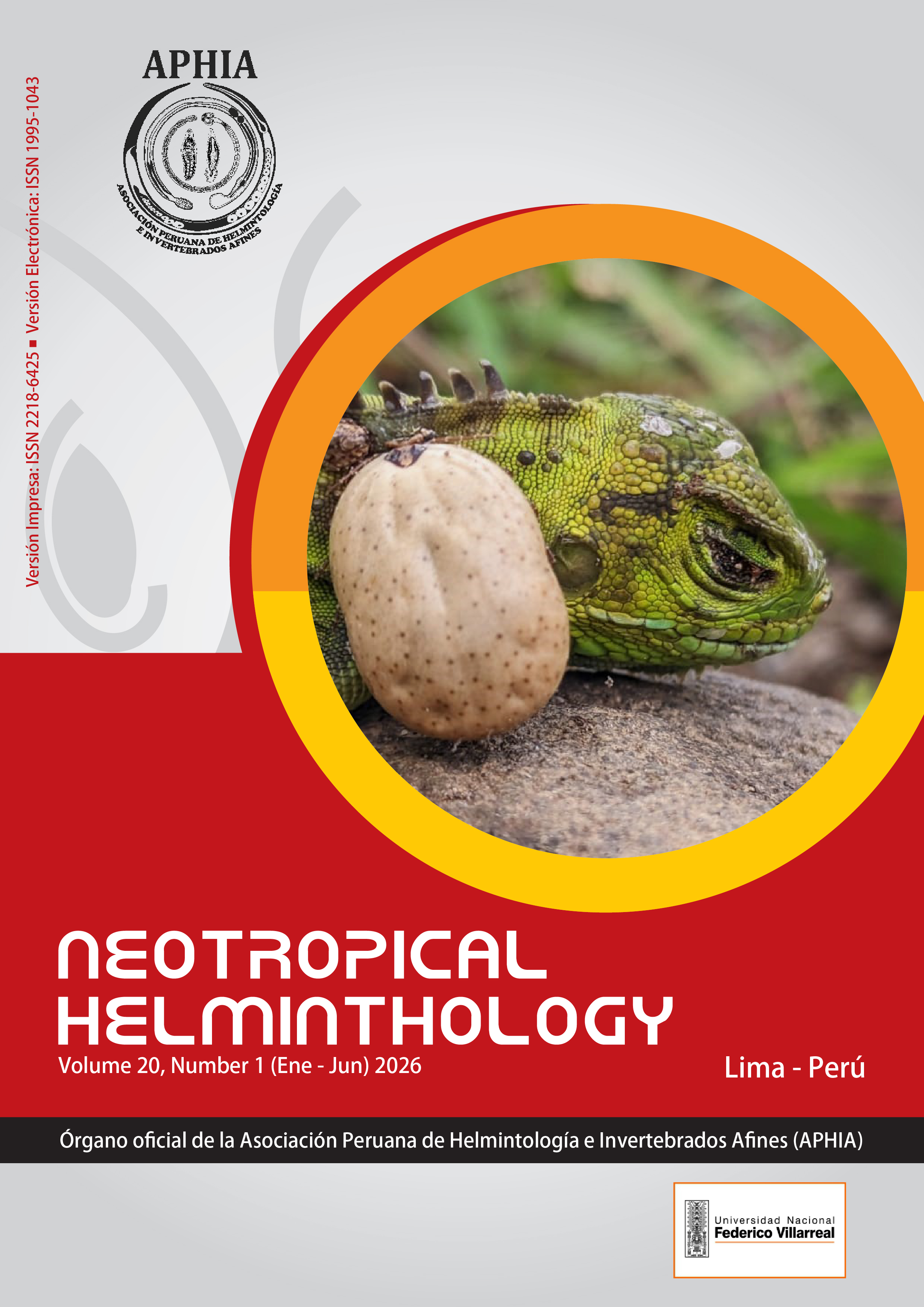
Seroprevalence of Ehrlichiosis, Babesiosis and Anaplasmosis in canines assisted in the Mascolive veterinary clinic in playa municipality of Havana, Cuba
DOI:
https://doi.org/10.62429/rnh20262012117Keywords:
ehrlichiosis, hemoparasites, One Health, seroprevalence, zoonosesAbstract
Among tick-borne diseases, several stand out as being of epidemiological importance, such as Lyme disease (borreliosis), ehrlichiosis, anaplasmosis, and babesiosis. These are emerging diseases and represent a significant public health problem. Globally, their numbers have doubled in the last ten years, and their geographic distribution has expanded. The objective of this study was to demonstrate the seroprevalence of ehrlichiosis, babesiosis, and anaplasmosis in canines treated at the "Mascolive" veterinary clinic in the Playa municipality of Havana, Cuba. The research was conducted between November 2023 and February 2024, during which 1.668 canines were treated at the aforementioned veterinary clinic, and 52 were classified as having clinical presentations compatible with hemoparasites (CCC-hemoparasites). Signs and symptoms were characterized for each animal, peripheral blood was examined microscopically, and a commercial antigen test was applied to determine antibodies against Ehrlichia spp., Anaplasma spp., and Babesia spp., demonstrating a seroprevalence of 86.54% for ehrlichiosis in the hemoparasites canine colonies (CCCs) during the study period. Less frequently, dogs positive for Ehrlichia spp. also exhibited co-infection with Anaplasma spp. or Babesia spp., or with Ehrlichia spp., Anaplasma spp., and Babesia spp. Canine distemper, gastroenteritis, inflammatory bowel disease (IBD), and Dirophilaria immitis (Leidy, 1856) were the most frequent complications. A high prevalence of Ehrlichia spp. is suggested among the dogs treated. The study concludes that veterinary care should be focused on One Health to prevent zoonoses.
Downloads
Published
How to Cite
Issue
Section
License

This work is licensed under a Creative Commons Attribution-NonCommercial-NoDerivatives 4.0 International License.
OBJETO: El AUTOR-CEDENTE transfiere de manera TOTAL Y SIN LIMITACIÓN alguna al CESIONARIO los derechos patrimoniales que le corresponden sobre la (s) obra(s) tituladas: xxxxxxxxxxxxxxxx, por el tiempo que establezca la ley internacional. En virtud de lo anterior, se entiende que el CESIONARIO adquiere el derecho de reproducción en todas sus modalidades, incluso para inclusión audiovisual; el derecho de transformación o adaptación, comunicación pública, traducción, distribución y, en general, cualquier tipo de explotación que de las obras se pueda realizar por cualquier medio conocido o por conocer en el territorio nacional o internacional.
REMUNERACIÓN: La cesión de los derechos patrimoniales de autor que mediante este contrato se hace será a título gratuito.
CONDICIONES Y LEGITIMIDAD DE LOS DERECHOS: El AUTOR-CEDENTE garantiza que es propietario integral de los derechos de explotación de la(s) obra(s) y en consecuencia garantiza que puede contratar y transferir los derechos aquí cedidos sin ningún tipo de limitación por no tener ningún tipo de gravamen, limitación o disposición. En todo caso, responderá por cualquier reclamo que en materia de derecho de autor se pueda presentar, exonerando de cualquier responsabilidad al CESIONARIO.
LICENCIA DE ACCESO ABIERTO: El AUTOR-CEDENTE autoriza que manuscrito publicado en La Revista Neotropical Helminthology permanece disponible para su consulta pública en el sitio web https://www.neotropicalhelminthology.com/ y en los diferentes sistemas de indexación y bases de datos en las que la revista tiene visibilidad, bajo la licencia Creative Commons, en la modalidad Reconocimiento-No comercial- Sin Trabajos derivados –aprobada en Perú, y por lo tanto son de acceso abierto. De ahí que los autores dan, sin derecho a retribución económica, a la Asociación Peruana de Helmintología e Invertebrados Afines (APHIA), los derechos de autor para la edición y reproducción a través de diferentes medios de difusión.