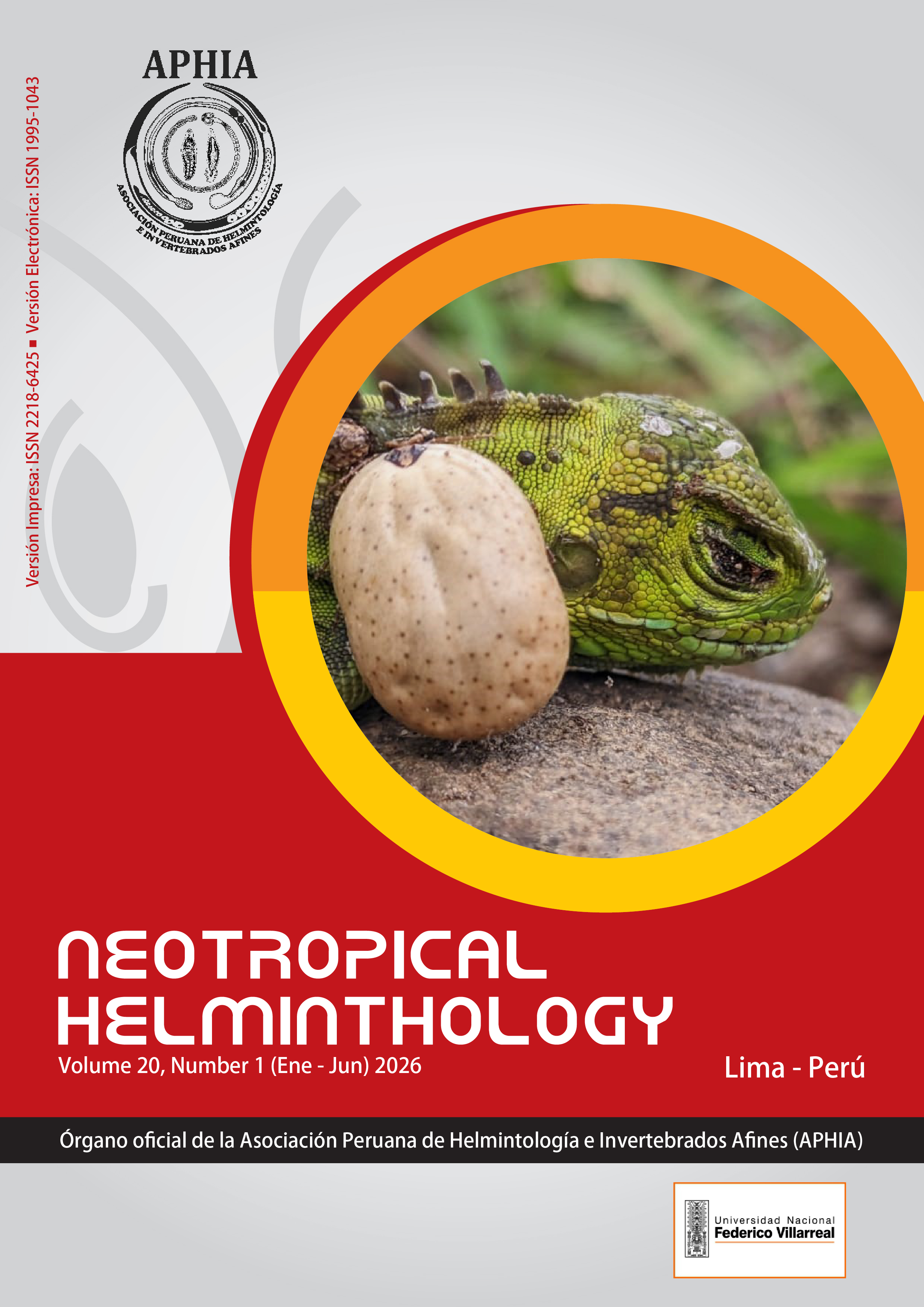
Diversidad de helmintos parásitos asociados con lagartos en un entorno poco estudiado del dominio de la Caatinga, en el noreste de Brasil
DOI:
https://doi.org/10.62429/rnh20262012113Palavras-chave:
Carrasco, Fauna helmíntica, Nematoda, Región neotropicalResumo
Este estudio presenta la composición de la comunidad de helmintos y los parámetros de infección parasitaria (abundancia, prevalencia, intensidad media de la infección) de cinco especies de lagartos recogidos en una zona de Carrasco, en la región noreste de Brasil. Las recolecciones se realizaron entre mayo y septiembre de 2021 en un entorno de carrasco situado en Chapada do Araripe, estado de Ceará, Brasil. Los especímenes se capturaron utilizando trampas y también manualmente durante búsquedas activas. Se recolectaron los parásitos encontrados y se estimaron los patrones de infección para cada especie. Se recolectaron un total de 239 parásitos de 21 huéspedes. La comunidad estaba compuesta predominantemente por nematodos. El lagarto Phyllopezus pollicaris (Spix, 1825) presentó la mayor diversidad parasitaria, y la especie de nematodo S. oxkutzcabiensis Chitwood, 1938 fue la más prevalente en la comunidad. La mayoría de las especies de nematodos se encontraron en el tracto gastrointestinal de los huéspedes. Los miembros parásitos de la familia Pharyngodonidae fueron los nematodos más comunes encontrados. Encontramos fuertes similitudes en la composición y distribución de las especies de endoparásitos en los entornos de Carrasco y la Caatinga adyacente. La comunidad de endoparásitos registrada era diversa, y algunas especies de nematodos estaban asociadas a especies hospedadoras específicas. Los lagartos E. bibronii Boulenger, 1885 Boulenger, 1885 y P. pollicaris se registran aquí como nuevos hospedadores de Onchocercidae y P. travassosi Pereira, 1935, respectivamente. Los datos aquí presentados proporcionan nueva información, ampliando el conocimiento sobre la composición de la fauna helmintológica de los lagartos que habitan en la Caatinga.
Downloads
Publicado
Como Citar
Edição
Seção
Licença

Este trabalho está licenciado sob uma licença Creative Commons Attribution-NonCommercial-NoDerivatives 4.0 International License.
OBJETO: El AUTOR-CEDENTE transfiere de manera TOTAL Y SIN LIMITACIÓN alguna al CESIONARIO los derechos patrimoniales que le corresponden sobre la (s) obra(s) tituladas: xxxxxxxxxxxxxxxx, por el tiempo que establezca la ley internacional. En virtud de lo anterior, se entiende que el CESIONARIO adquiere el derecho de reproducción en todas sus modalidades, incluso para inclusión audiovisual; el derecho de transformación o adaptación, comunicación pública, traducción, distribución y, en general, cualquier tipo de explotación que de las obras se pueda realizar por cualquier medio conocido o por conocer en el territorio nacional o internacional.
REMUNERACIÓN: La cesión de los derechos patrimoniales de autor que mediante este contrato se hace será a título gratuito.
CONDICIONES Y LEGITIMIDAD DE LOS DERECHOS: El AUTOR-CEDENTE garantiza que es propietario integral de los derechos de explotación de la(s) obra(s) y en consecuencia garantiza que puede contratar y transferir los derechos aquí cedidos sin ningún tipo de limitación por no tener ningún tipo de gravamen, limitación o disposición. En todo caso, responderá por cualquier reclamo que en materia de derecho de autor se pueda presentar, exonerando de cualquier responsabilidad al CESIONARIO.
LICENCIA DE ACCESO ABIERTO: El AUTOR-CEDENTE autoriza que manuscrito publicado en La Revista Neotropical Helminthology permanece disponible para su consulta pública en el sitio web https://www.neotropicalhelminthology.com/ y en los diferentes sistemas de indexación y bases de datos en las que la revista tiene visibilidad, bajo la licencia Creative Commons, en la modalidad Reconocimiento-No comercial- Sin Trabajos derivados –aprobada en Perú, y por lo tanto son de acceso abierto. De ahí que los autores dan, sin derecho a retribución económica, a la Asociación Peruana de Helmintología e Invertebrados Afines (APHIA), los derechos de autor para la edición y reproducción a través de diferentes medios de difusión.